
AI Chatbot Handover Rules: When a Bot Should Pass to a Human
Learn the human handover rules that keep an AI chatbot from losing enquiries, with trigger phrases, response times and privacy checks you can set up now.
Finchbyte Team 8 min read
A visitor asks your website chatbot about pricing for a multi-site rollout. The bot answers with a brochure link, the visitor asks again, the bot repeats itself, and the tab closes. Nothing was broken technically. The bot simply never handed the conversation to a person, and the enquiry died in a chat window.
Good AI chatbot human handover rules are the difference between a bot that books meetings and a bot that quietly filters leads out of your pipeline. This guide covers the triggers that should force a handover, the timing that works, how to write the rules so your team actually follows them, and the privacy checks to run before the bot goes live.
Why Handover Rules Decide Whether a Bot Earns Its Keep
A chatbot is useful because it answers instantly, at 11pm, on a Sunday, when nobody is at a desk. It fails when it keeps answering after the conversation has stopped being a question and started being a buying signal. Most lost bot conversations are not caused by weak AI. They are caused by the bot continuing to talk when a person should have stepped in.
Say your clinic gets 40 enquiries a month from paid ads and books only 8. If the bot handles the first reply and then waits for someone to notice the chat, most of those 40 never become a booked appointment. Handover rules close that gap by turning a defined moment in the chat into an alert, a task and a named owner. If you are still choosing a first workflow, our AI automation guide for small business covers where automation pays back fastest.
The Five Triggers That Should Always Hand Over
Not every message needs a human. These five do, and they cover the bulk of high-value conversations in a service business.
- Buying signals. Phrases such as "how much", "can you quote", "do you serve our area" or "what is your timeline" mean a decision is being made, and a bot answer rarely closes it.
- Price and contract questions. Anything about custom pricing, discounts, payment terms or a written proposal belongs with someone who can commit.
- Complaints and distress. A frustrated customer or a patient describing a health concern should reach a person quickly, with the transcript attached.
- Repeated confusion. If the bot has answered the same question twice, or the visitor asks it a third way, treat that as a failure signal and escalate.
- Requests for personal data. Collecting health details, financial information or anything sensitive should move to a controlled channel with consent captured first.
Write these five as a one-page rule sheet your sales and support teams can read in two minutes. Ambiguity is what causes a bot to keep chatting while a deal cools.
Set the Clock: Response Times That Keep Deals Warm
Speed matters more than wording. A handover rule with no clock attached is a suggestion, and suggestions get ignored when the team is busy. The table below shows the timing bands we suggest starting with, and what should happen inside each one.
| Stage | Target time | What happens |
|---|---|---|
| First bot reply | Under 10 seconds | Bot answers or confirms it has logged the enquiry |
| Handover alert to team | 2-5 minutes | Named owner sees the chat and the visitor's history |
| Human reply during business hours | 5-15 minutes | Person replies in the same thread, bot steps back |
| Human reply after hours | 30-60 minutes next morning | Bot confirms a person will reply and books a slot |
| Unresolved chat escalation | 24-48 hours | Supervisor reviews and calls the visitor |
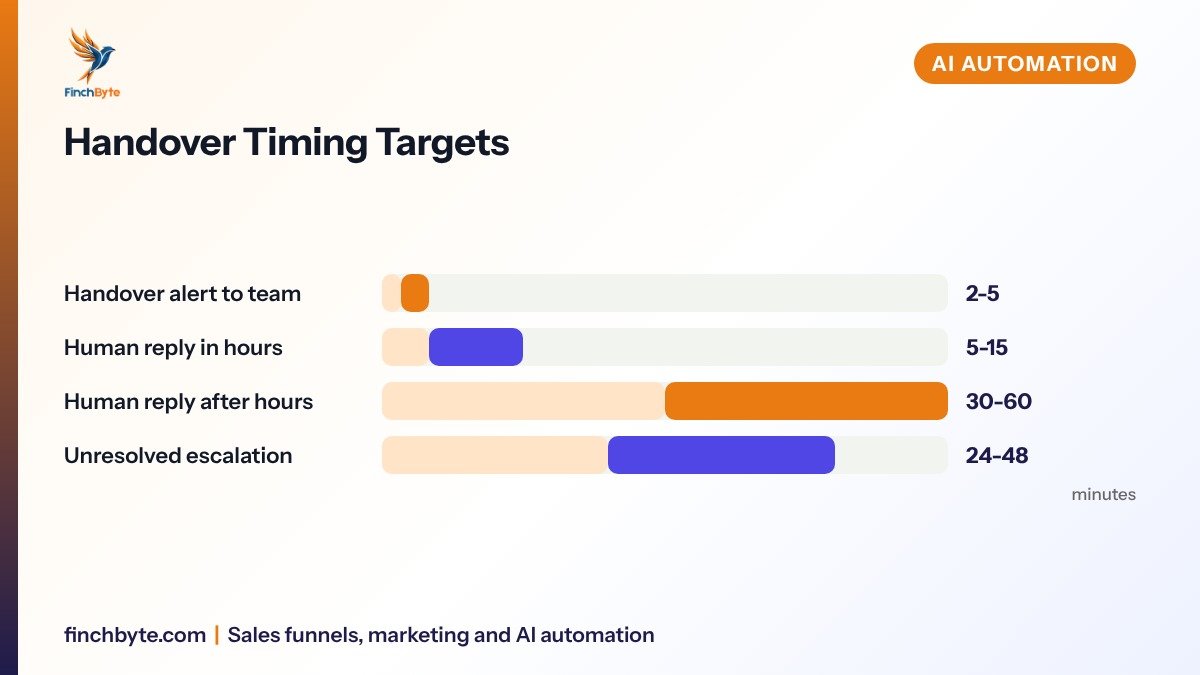
Under 15 minutes in business hours keeps most enquiries recoverable. Beyond a day, the visitor has usually spoken to two other suppliers. If you also run paid campaigns, our note on Lead follow-up process explains how these chat timings fit alongside phone and email follow-up.
Who Owns Each Trigger
Assign one owner and one backup per trigger, not a shared inbox. A buying signal sent to a general queue is a buying signal that waits. Routing by trigger also lets you measure each one separately, which is how you find the leak later.
Writing the Handover Rules Your Team Will Follow
Rules fail when they live in a document nobody opens. Put them where the bot and the humans both act on them.
- List every trigger phrase. Pull the last 60-90 days of chat transcripts and tag each message as answer, buying signal, complaint or data request. The buying-signal list becomes your trigger set.
- Set one action per trigger. Each trigger gets a single outcome: alert a named person, open a CRM task, or move to a phone or WhatsApp thread. Never two at once.
- Write the bot's handover message. One short line that sets expectations, such as "I have asked Priya from our team to reply here, usually within 10 minutes."
- Log the handover in your CRM. Every escalation should create or update a lead record with the trigger name, so you can report on it.
- Review the missed handovers weekly. Read the ten chats that ended without a human reply and adjust one trigger.
Keep each rule to one sentence. If a rule needs a paragraph to explain, the bot logic behind it is too complicated.
A bot that never hands over is not efficient, it is just early in the loss.
Handover Mechanics on WhatsApp, Web Chat and Voice
The rule is the same everywhere, but the plumbing differs. WhatsApp assistants need an opt-in and a clear path to a person, since messaging policies and India's DPDP Act both expect a visible way to reach a business. Web chat can pass the full transcript into your CRM. Voice bots need a warm transfer, because a caller who is told "someone will call you back" usually hangs up and dials a competitor.
For clinics and real estate teams running a messaging assistant, the same trigger logic applies to patient or buyer conversations, and WhatsApp follow-up for clinics covers the timing side in that setting. For B2B companies, a handover from a site bot to a founder or an account executive often reads as better service than a form, especially when the buyer is comparing three vendors.
What the Human Sees on Handover
A person who gets a handover should never ask "who is this?". Show them the visitor's source campaign, pages viewed, previous chats, and the exact message that triggered the alert. That context is what turns a 15-minute reply into a useful conversation instead of an interrogation.
Privacy Checks Before the Bot Goes Live
A chatbot collects data in a conversational way, which means it can capture personal information nobody intended to store. Run these checks before launch and again every quarter.
- Consent is visible. The bot states that the chat is recorded and how the data is used, before it asks anything personal.
- Sensitive data has a boundary. The bot is instructed not to ask for health details, account numbers or government ID, and to move those chats to a secure channel.
- Retention is set. Decide how long transcripts are stored and delete on request, keeping CASL, PIPEDA, the DPDP Act or GDPR expectations in mind for your contacts.
- Access is limited. Only named staff can read transcripts, and the list is reviewed when people leave.
- The opt-out works. A visitor who asks for a human, or asks to stop messaging, gets both immediately, every time.
These are general checks, not legal advice. Have your own counsel confirm the rules for the markets you contact.
Common Mistakes to Avoid
- Letting the bot answer price questions with a generic link, which is the single most common way a warm enquiry cools.
- Sending handover alerts to a shared inbox instead of a named owner with a backup.
- Counting "bot resolution rate" as the main metric, which quietly rewards the bot for never escalating anything.
- Building triggers from opinions rather than from real transcripts, so the list misses how buyers actually phrase things.
- Skipping the after-hours path, which is when a large share of enquiries arrive and the bot is the only thing listening.
- Turning the bot off entirely after one bad complaint, instead of fixing the one trigger that failed.
What to Ask Before Hiring an Agency
If a supplier is building and running your assistant, get clear answers on five things before you sign. Ask exactly which workflows and triggers are in scope, and what is billed separately. Ask what the monthly report shows and whether it ties chats to booked meetings or just to message volume. Ask who owns the bot configuration, the transcripts and the phone number, and what you receive if you leave. Ask how long trigger changes take, and whether you can change them yourself. Finally, ask how handovers are logged and measured, because a bot with no handover reporting is a bot you cannot improve.
Conclusion
Handover rules are what make an AI chatbot safe to put in front of your buyers: define the five triggers, put a clock on each one, route to a named owner and log every escalation in your CRM. Start with real transcripts, review the missed handovers weekly, and the assistant becomes a booking tool rather than a polite dead end.
Want this set up for your business? Book a free growth audit or Talk to Finchbyte.
Disclaimer: Results vary by business, market, budget and execution. This article is general guidance, not a promise of specific rankings, leads or revenue.
Frequently asked questions
How many handover triggers should a chatbot start with?
Start with five: buying signals, price or contract questions, complaints or distress, repeated confusion, and requests to share personal data. Add more only after you have read real transcripts for a month.
How fast should a human reply after the bot hands over?
During business hours, aim for 5-15 minutes in the same thread. After hours, the bot should confirm that a person will reply and offer to book a slot, with a human reply inside the first hour of the next working day.
Should the bot tell visitors it is an AI assistant?
Yes. Say plainly that it is an assistant and that a person can take over at any time. Clear disclosure reduces complaints and makes the handover feel like service rather than a failure.
What metrics show whether handovers are working?
Watch handover rate (what share of chats escalate), time from trigger to first human reply, and booked meetings per escalated chat. Compare escalated chats against bot-only chats on bookings, not on message counts.
Can a WhatsApp assistant hand over to a person under messaging rules?
It can and should. Keep a visible opt-in, honour stop requests immediately, and give a clear path to a human. Business messaging platforms and privacy laws such as India's DPDP Act both expect a reachable business, not an automated loop.
Do voice bots need the same rules as chat?
The triggers are the same but the mechanics differ. Use a warm transfer to a live person where possible, since callers told that someone will call back often ring a competitor instead.
How often should handover rules be reviewed?
Review missed handovers weekly for the first month, then monthly. Re-check privacy settings quarterly, or whenever you change the bot model, the CRM fields or the markets you serve.
- #AI chatbot human handover rules

