WhatsApp Follow-Up for Clinics: Answer Patient Enquiries Before They Go Cold
A practical WhatsApp follow-up system for clinics: answer patient enquiries fast, triage them into the right queue, and follow up with dated next steps before they go cold.
Finchbyte Team 8 min read

A patient types a short question into your clinic's WhatsApp number at 8:40 in the evening: "Do you take my insurance, and how soon is the earliest appointment?" Nobody is at the desk. By morning, that patient has booked somewhere else and your message sits unread in a long list. Weak WhatsApp follow-up for clinics looks exactly like this: real demand arriving on a channel nobody owns.
This guide is for clinic owners, practice managers and front desk teams who already receive WhatsApp enquiries and want a system that answers them properly. We will cover reply windows, triage, follow-up messages, where automation genuinely helps and where it should stop, without inventing statistics or promising booking numbers.
Why clinic enquiries go cold on WhatsApp
WhatsApp feels informal, so clinics often treat it as a side channel that anyone might answer if they have a spare minute. That is the core problem: an informal channel with a formal expectation attached. Patients expect a chat reply, not an email answer in two days.
Three patterns cause most of the losses. The first is ownership: the number lives on a shared phone, and every staff member assumes someone else replied. The second is sameness: a complex treatment question and a parking question land in the same list and get the same generic answer. The third is the missing second step: someone answers once, the patient goes quiet, and the chat never appears on anyone's to-do list again.

None of these are technology problems. They are process problems that happen to live in a messaging app, which is why clinics with modest setups often outperform clinics with expensive software and no owner.
Set one reply window and name one owner
Decide the maximum time a patient should wait for a first human reply during your opening hours, and write it down. Many clinics find a target measured in minutes during staffed hours is realistic, and a stated "we will reply when we open" message handles the rest of the day.
Then name one person who owns the queue for each shift. Ownership means they see every unread chat, they route anything they cannot answer, and they close the loop before handover. If two people can answer, only one of them is accountable for a given chat.
Put the reply window where staff see it, not only in a handbook. A printed card at the desk and a saved reply that states the window are usually enough to make the standard real.
Sort enquiries into four queues
Triage is the single highest-value habit. Before anyone types, decide which of four buckets a message belongs in, because each bucket needs a different response and a different person.
| Queue | Typical message | Who answers and how fast |
|---|---|---|
| Booking | Earliest availability, fees, insurance | Front desk, inside the reply window |
| Service question | What a treatment involves, recovery time | Front desk from approved notes |
| Clinical | Symptoms, medication, second opinions | Clinician, in a private channel |
| Complaint or record request | Bill dispute, file copy request | Practice manager, same business day |
Label each chat in your WhatsApp Business app or CRM with its queue so the count of open items per bucket is visible at a glance. If "service question" is always the biggest pile, that is a sign your website or service page is not answering the question, which our service page FAQs guide covers in more detail.
Write replies patients can act on
A good WhatsApp reply does three things: confirms what was asked, answers the part you can answer, and offers one obvious next step. Most clinic replies fail on the last one. They end with "let us know if you have questions", which puts all the work back on the patient.
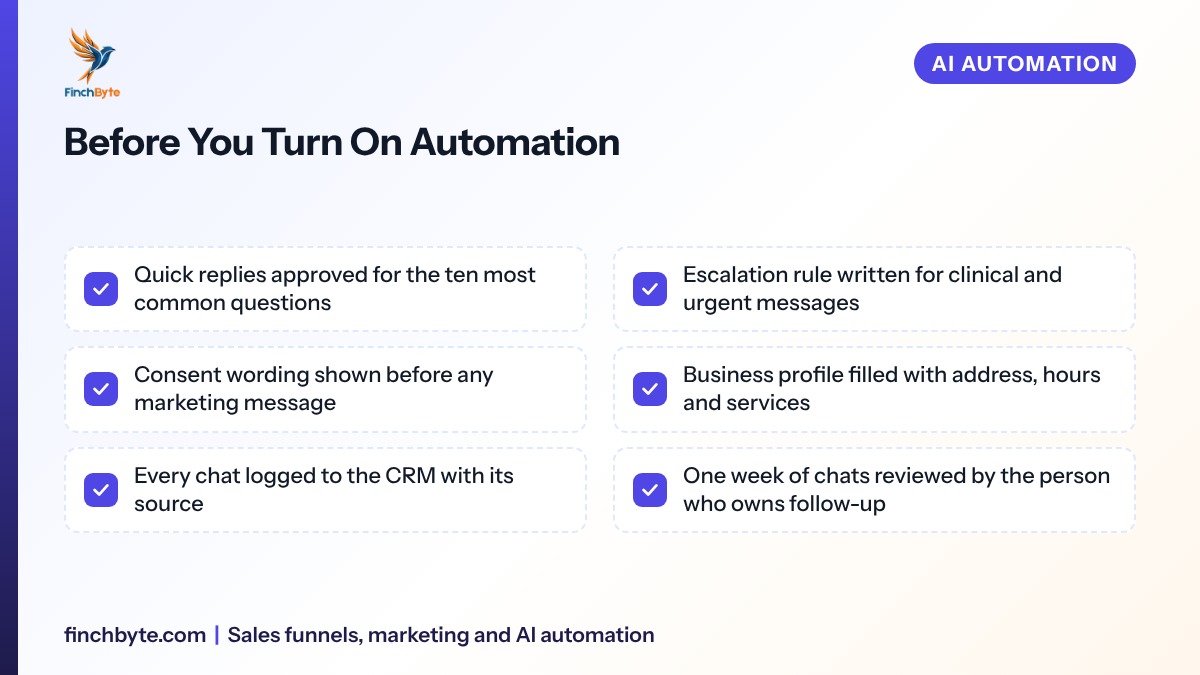
Build a short library of saved replies for the ten most common questions. Each one should be a starting point a person edits, not a script they paste unchanged. Include the two or three details patients actually need: what to bring, how long the visit takes, what the fee range looks like in general terms, and how to confirm.
Every open chat needs a named owner, a next step and a date, or it is not being followed up.
Follow up twice, then close the chat
Most patient chats go quiet after one exchange, and silence is not a no. It is usually a person comparing clinics, waiting for a spouse's opinion or simply busy. A short, dated follow-up recovers a fair share of those conversations, and it costs nothing but a minute.
- Log it the moment it opens. Create the contact and the chat record in your CRM with its source (Google, Instagram, a sign, a referral) so nobody has to reconstruct it later.
- Set a next action with a date. "Call to confirm Tuesday 10:00" or "send fee breakdown", never "follow up". Our lead follow-up process guide explains how to write these so they actually get done.
- Send follow-up one within two working days. Reference their original question and offer two specific time options instead of an open invitation.
- Send follow-up two around day seven. Change the angle: offer a different time, a shorter first visit, or a link to a page that answers the question they hesitated on.
- Close it with a reason. Mark the chat booked, not interested, or parked with a future date, so the open list stays honest and small.
Two follow-ups is enough for most patient enquiries. Beyond that you are messaging, not helping, and repeated unanswered pings damage the goodwill the first reply earned.

Where automation helps and where it must stop
Automation earns its place in the first ninety seconds and in the boring parts: acknowledging a message outside hours, asking what the enquiry is about, collecting the details a booking needs, and reminding staff about open chats. A well-built assistant can hold a conversation that ends with a booked slot or a clean handover.
It should stop at anything clinical, anything emotional, and anything involving personal health information. A patient describing symptoms needs a clinician, not a chatbot paraphrasing a blog. Build the handover rule first: which words and situations always route to a human, and what the assistant says while it waits.
For consent and privacy, keep marketing messages separate from enquiry replies, ask before sending promotional messages, and respect opt-outs immediately. In Canada that means being aware of PIPEDA for personal information and CASL for commercial electronic messages; in India, the DPDP Act applies to similar situations. Treat those as general obligations to check with your own privacy adviser, not as legal advice from this article. WhatsApp's own Business messaging policies also limit bulk and unsolicited messages, so design for conversations rather than broadcasts.
If you are deciding what to automate first across the clinic, our guide on choosing your first AI automation workflow gives a simple way to rank candidates by risk and repetition.
Set up the channel properly
Small setup details decide whether the channel feels trustworthy. Complete the business profile with your address, hours, services and a website link, because patients check it before they send the first message. Use the catalogue or a pinned message for fees and service lists rather than repeating them by hand.
Choose the right tier of tooling. The free WhatsApp Business app handles one clinic with one or two staff well. An API connection earns its cost when several people answer, you need approved message templates, routing by queue, or chats recorded automatically against a patient record in your system. That is the kind of setup we build in our AI automation services, usually alongside the CRM pipeline the chats land in.
Make sure the channel is findable
Enquiries cannot arrive if nobody knows the number exists. Add a WhatsApp button to the pages patients actually read, especially your service and location pages, and keep the number identical everywhere it appears. A mismatched number between your website and your Google Business Profile costs enquiries quietly.
If your clinic depends on local search, the WhatsApp button is one part of a broader presence question. Our local SEO checklist for Ontario service businesses covers the profile and listing work that feeds the same inbox, and the same consistency helps when patients ask AI assistants which clinic near them is worth contacting.
Measure the queue every month
Four numbers tell you whether the system works: median first-reply time during staffed hours, the share of chats that become a booked appointment, the share that end unanswered, and where the chats came from. Keep them in one small sheet, reviewed by the same person each month, so you see movement instead of a snapshot.
Give the review a fixed owner and a fixed slot, fifteen minutes is usually enough. Read three chats from each queue, not just the average. Averages hide the one queue that is losing patients, and reading actual threads is how you find the saved reply that needs rewriting. If you also run paid campaigns pointing at WhatsApp, our GA4 lead tracking guide shows how to connect campaigns to enquiries rather than clicks.
Avoid these follow-up mistakes
- Leaving the number on a personal phone with no shared access or handover rule.
- Auto-replies that sound final, so staff assume the patient was handled.
- Sending the same generic reminder to a booking question and a clinical concern.
- Following up with a link and no question, which invites no reply.
- Using patient chats to broadcast promotions without consent.
- Counting messages sent instead of appointments booked.
Make every patient chat end in a decision
Good WhatsApp follow-up for clinics is not about messaging more. It is a short list of habits: one owner per shift, a stated reply window, four queues, replies that offer a next step, two dated follow-ups and a monthly read of the queue.
Start by assigning the owner and writing the ten saved replies this week; the rest of the system grows from there. If you want the channel wired into a funnel that records every chat, routes it to the right person and reports bookings instead of messages, see our AI automation services or request a free growth audit and we will review your current enquiry flow with you.
Frequently asked questions
Is WhatsApp a good channel for patient enquiries in Canada?
Many patients already use WhatsApp to reach clinics, so meeting them there reduces friction. It works best for first contact, scheduling questions and simple service questions, with clinical matters moved to a private channel. Whatever channel you use, keep response times and records consistent.
How fast should a clinic reply on WhatsApp?
Aim for a first reply within minutes during staffed hours, and an automatic message that states when a person will answer for outside hours. Speed matters most in the first few minutes, because patients usually contact more than one clinic at the same time. Track your median first-reply time weekly and fix the queue that causes the delay.
Can a clinic automate WhatsApp replies without breaking privacy rules?
Automation can send a first reply, ask triage questions and route the chat, as long as clinical advice, personal health information and complaints go to a person. Keep marketing messages separate, ask for consent before sending them, and follow the rules that apply to you, such as PIPEDA in Canada and CASL for commercial electronic messages. WhatsApp's own Business policies also restrict bulk and unsolicited messaging.
Do we need a WhatsApp Business API for a clinic?
Not always. The free WhatsApp Business app suits a single clinic with one or two staff answering chats. An API setup makes sense when several people answer, you want message templates and routing, or you need chats recorded automatically in your CRM. Start simple and upgrade when volume or handover errors justify it.
What should a WhatsApp follow-up message say?
Reference the original question, offer one clear next step and give two or three time options. Keep it short, avoid clinical advice, and send it at a sensible hour. For example, a dental clinic might ask whether Tuesday morning or Thursday afternoon suits a consultation, rather than sending a generic reminder.
How do we measure whether WhatsApp follow-up is working?
Watch four numbers: median first-reply time, share of chats that become a booked appointment, share that close as "not interested" or unanswered, and where the enquiries came from. Review them monthly with the same person who owns the queue, and compare against the previous month rather than against a competitor.
- #whatsapp follow-up for clinics
- #patient enquiries
- #clinic lead follow-up
- #WhatsApp Business
- #AI automation