AI Search Visibility Report: What to Check Each Month
Build an AI search visibility report that tracks ChatGPT, Gemini and AI Overview mentions, citations and referrals. Here is the monthly check and template.
Finchbyte Team 8 min read
A founder sends you a screenshot. Someone asked ChatGPT for "the best CRM setup for a small clinic in Mississauga" and the answer named three competitors. Your name never appeared, and nobody on your team can say whether that has been happening for weeks or years.
That blind spot is what an AI search visibility report closes. It is a simple monthly check of how AI assistants describe and recommend your business across ChatGPT, Gemini, Perplexity, Claude and Google AI Overviews, plus what those answers actually send you in calls and enquiries. Below is the report structure, the timing, and a routine that takes 60-90 minutes a month.
What an AI Search Visibility Report Actually Tracks
Most businesses already track rankings and clicks, which say nothing about assistants. An assistant does not rank you; it summarises sources and picks names. So the report needs its own measures.
Five of them carry the whole thing. Mention rate is how often your business appears in the answers at all. Sentiment and description covers how the assistant words it, whether "specialises in manufacturing enquiries" or a vague generic line. Citations are the pages the assistant links to or names as sources. Referral traffic is the visits arriving from assistant domains. Lead impact is what those visits turn into.
If you want the deeper mechanics of being named at all, our guide on How to get your business recommended by ChatGPT covers the entity and source work behind these numbers.
Choose Questions Worth Reporting
The report lives or dies on the question set. Ten to fifteen questions, written the way a buyer types them, beat a list of head terms. Each one should include a buying intent, a place and a qualifier.
Build the set from four buckets:
- Service plus city. "Best sales funnel agency in Toronto" and "CRM setup for clinics in Brampton" test whether you show up locally.
- Problem phrased as a symptom. "Why do my Google Ads enquiries never turn into booked calls" tests whether the assistant explains your solution and names you.
- Comparison questions. "Finchbyte vs [two competitors] for B2B lead generation" tests how you are described next to rivals.
- Cost and fit questions. "How much does a landing page cost for a manufacturer" tests whether your pricing page is the source used.
Refresh the set every quarter, not monthly, so your month-over-month numbers mean something. Pull new phrasings from your real enquiry emails and call transcripts, since those are the sentences your buyers actually use.
The Tools to Check and How Long Each Takes
You need four surfaces, checked from a clean browser or logged-out session so your own history does not skew the answers. Run each question in each tool twice and note whether the two answers agree.
| Surface | What to note | Minutes per month |
|---|---|---|
| ChatGPT | Mentions, description wording, linked sources | 20-30 |
| Gemini | Mentions, local pack and map references | 15-20 |
| Perplexity | Which pages are cited by name | 10-15 |
| Google AI Overviews | Whether an overview appears and which sites it links | 15-20 |
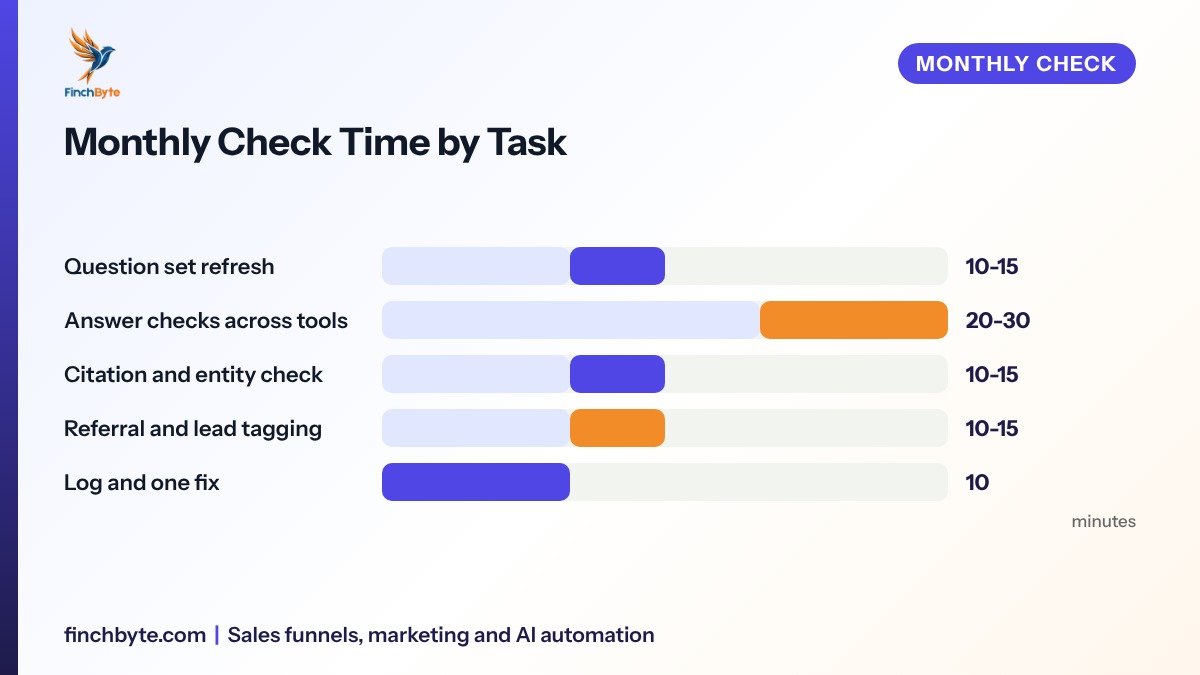
Sixty to ninety minutes total is realistic for a 10-15 question set. Add 15 minutes if you also check Claude. Spread the checks across two days so you are not squinting at forty tabs at once, and always use the same phrasing you logged last month.
The time splits roughly like this:
Read Citations Before You Chase Mentions
Mentions feel like the headline number, but citations explain them. An assistant names you when something trustworthy already says you exist and what you do.
Pull every source the assistants linked across your question set and sort them into three groups. Your own pages (service pages, location pages, pricing, FAQ sections). Third-party sources (directories, review platforms, industry listings, news and trade coverage). Competitor pages that appear where you do not.
Two checks fall straight out of that list. First, whether your own pages are readable enough to be quoted, which is the same work as making a page answer a question in its first paragraph; our breakdown of Service page FAQs shows that pattern. Second, whether your name, address, phone and service description match everywhere you appear, because conflicting details make an assistant hedge or drop you. That consistency work is covered in our Local SEO checklist for Ontario service businesses.
Fix the sources the assistants already trust before you write anything new.
Measure Referrals Without Guessing
Referral data is the least flattering part of the report and the most useful. Visits from assistant domains are real, but they arrive in analytics labelled in ways that hide them.
In GA4, build a simple filter or a custom report for referrers containing Chatgpt.com, Perplexity.ai, Gemini.google.com and Claude.ai. Expect small numbers, often 10-40 sessions a month for a local or niche B2B site, and expect Google AI Overview clicks to land inside google or organic search rather than as their own source. Tagging campaign links properly helps you separate an assistant visit from an ad click; UTM tracking for small businesses walks through a naming scheme that survives into CRM reports.
For split tests, keep GA4 lead tracking as your yardstick rather than raw sessions. An assistant visit that reads your pricing page and then calls you is worth more than five that bounce, and only the lead count shows that.
Here is a realistic shape for a niche business in its first quarter of tracking:
Those shares vary a lot by market and question type. Treat them as an illustration of the mix, not a forecast.
Turn the Numbers Into a Monthly Table
Put it in a spreadsheet with one row per month and keep it there. A report nobody can compare against last month changes nothing.
| Month | Mention rate (%) | Pages cited | AI referral sessions | AI-sourced enquiries |
|---|---|---|---|---|
| January | 10-20 | 4-6 | 10-20 | 0-1 |
| February | 20-30 | 6-8 | 15-25 | 1-2 |
| March | 30-40 | 8-12 | 20-35 | 2-3 |

Every number above is an illustrative range for a single business with a modest question set, not a benchmark. What matters is direction and the note column beside it: which fix you shipped, and whether anything moved.
Keep three columns of notes. What you changed (a new FAQ block, a directory corrected, a review profile updated). What the assistants started doing differently. What you will test next month.
The 60-Minute Monthly Routine
- Lock the question set. Open last month's sheet and confirm the 10-15 questions are unchanged, adding new ones only at the quarterly review.
- Run the checks. Ask each question in ChatGPT, Gemini, Perplexity and an AI Overview query, twice, and paste the answers into a folder dated for the month.
- Score each answer. Record mentioned or not, one line on how you were described, and every source linked.
- Pull referral numbers. Filter GA4 for assistant referrers for the month and count form fills and calls attributed to those sessions.
- Log one fix. Pick the single highest-use gap, usually a missing or unreadable source, and assign it an owner and a date.
- Compare and decide. Read the month-over-month row. If mention rate is flat for three months, the problem is your source base, not your question set.
Sixty to ninety minutes covers all six steps. The discipline is step five: one fix per month, shipped, beats a list of ten observations.
Common Mistakes to Avoid
- Checking from your own logged-in account. Personalisation changes answers, so your numbers drift for reasons that have nothing to do with your site.
- Tracking head terms instead of buyer questions. A keyword list tells you nothing about how an assistant describes your pricing or your specialty.
- Publishing AI-flavored pages to chase citations. Thin, machine-generated pages add little and can drag how your whole domain reads; useful, specific pages are what get quoted.
- Ignoring the description, only the mention. Being named as a generic option alongside thirty others is a weak signal, and the wording is what a reader acts on.
- Rebuilding the question set every month. You lose comparability and cannot tell a real change from a changed question.
- Treating AI Overview clicks as their own channel. They sit inside organic search in most reports, so check the queries that trigger them in Search Console instead.
What to Ask Before Hiring an Agency
If an agency offers to handle this for you, five questions separate a real service from a slide.
- Scope. Which tools and how many questions per month, and whether they paste the actual answers as evidence rather than a summary of them.
- Reporting. Whether you get the raw answer logs and a month-over-month sheet you keep, not just a traffic-light dashboard.
- Ownership. Who controls your analytics, Search Console, directory listings and review profiles, and what happens to that access if you leave.
- Timelines. What they expect to change in what order, stated as checks rather than guarantees, since nobody can promise an assistant's wording.
- Tracking. How AI referrals are separated from organic and paid, and how leads get tagged so the numbers reconcile with your CRM.
Ask to see a redacted copy of a report they run today. If the evidence is screenshots without dates or a single blended "AI traffic" number, the reporting is not real. Finchbyte's AI search optimisation service is built around exactly this kind of logged evidence, alongside the technical and content work behind it.
Conclusion
An AI search visibility report is not a new analytics platform. It is a fixed set of buyer questions, run the same way each month across ChatGPT, Gemini, Perplexity and Google AI Overviews, scored for mentions, descriptions and citations, then reconciled against the referral sessions and enquiries those answers actually produce. Do it for three months and you will know whether assistants are a quiet source of qualified work for you or a place where competitors keep your name out.
Want this set up for your business? Book a free growth audit or Talk to Finchbyte.
Disclaimer: Results vary by business, market, budget and execution. This article is general guidance, not a promise of specific rankings, leads or revenue.
Frequently asked questions
How many questions should be in an AI search visibility report?
Ten to fifteen buyer-style questions, each with a service, a place and a qualifier. Keep the set fixed month to month and only add new phrasings at a quarterly review, so your numbers stay comparable.
How do I see traffic from ChatGPT in Google Analytics?
Filter GA4 for referrers containing chatgpt.com, perplexity.ai, gemini.google.com and claude.ai. Google AI Overview clicks usually appear inside google organic traffic rather than as their own source, so check the triggering queries in Search Console as well.
How long does the monthly AI visibility check take?
Sixty to ninety minutes for a 10-15 question set across four tools, or about 15 minutes more if you include Claude. Spreading the checks over two days keeps the answers easier to read and compare.
Do AI Overviews and ChatGPT give the same answer?
Rarely. AI Overviews summarise pages Google already ranks and links to them, while assistants like ChatGPT and Perplexity draw on a wider mix of sources and their own training. Check each separately and note where they disagree.
What is the difference between a mention and a citation?
A mention is your business being named in an answer. A citation is a specific page linked or named as a source. Citations drive mentions, so fixing a well-read source page usually moves mentions before anything else does.
How often should I refresh the question set?
Quarterly. Refreshing monthly destroys month-over-month comparison and makes it impossible to tell a real change in visibility from a changed question.
Can an agency guarantee my business appears in AI answers?
No. Assistants change models, sources and phrasing constantly, and anyone promising a specific placement or wording cannot control that. What an agency can do is improve the sources those answers rely on and log the results honestly.
- #AI search visibility report