Proposal Follow-Up for B2B Services: A 10-Day Plan
A practical 10-day proposal follow-up plan for B2B service teams: what to send on each day, how to track it in the CRM and how to review stalled quotes.
Finchbyte Team 8 min read

You sent a well-built proposal on Monday. By Friday there is no reply, no questions, no decision. The buyer has not vanished. They are comparing two or three other suppliers, waiting on a colleague who has not read the document yet, or simply busy. What decides the outcome is usually not a better proposal but proposal follow-up for B2B services that keeps the conversation moving without turning into pressure.
This guide is for owners, founders and sales managers at B2B service companies: agencies, consultancies, IT and accounting firms, engineering and design practices, and the service arms of manufacturers. It covers a 10-day follow-up sequence you can run in a CRM, what to write in each message, how to track stalled quotes, and what to review each month. No invented reply rates or figures, just a process you can set up this week.
Why proposals go quiet after you send them
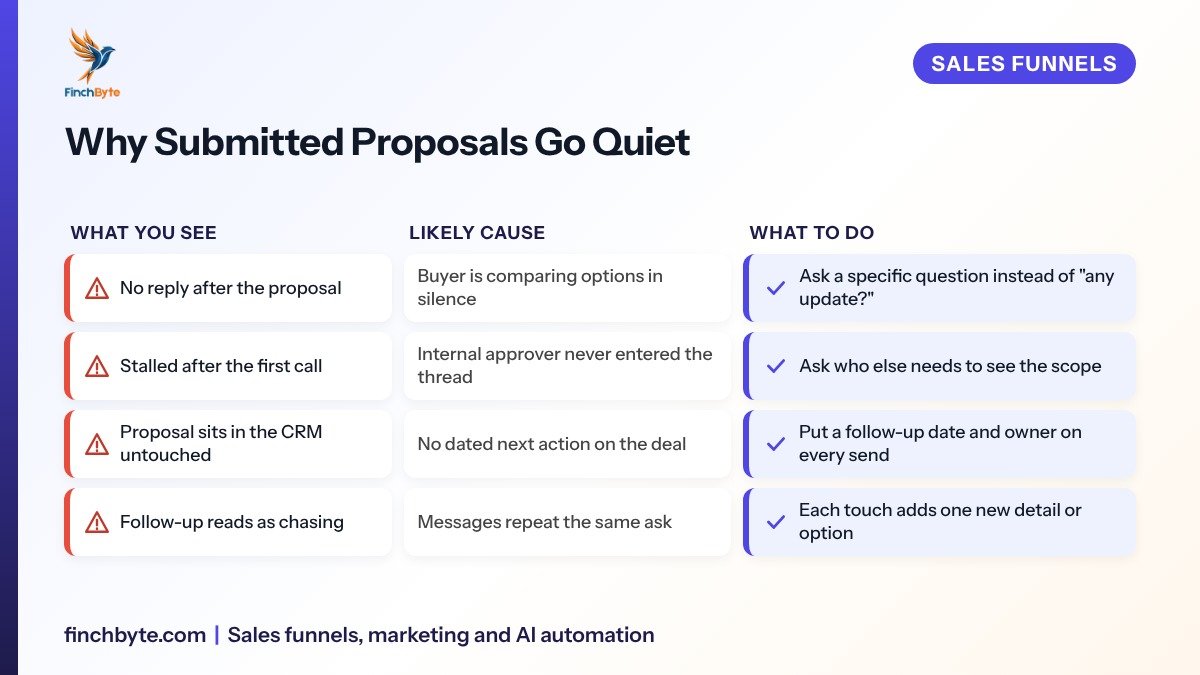
A proposal is the moment the buyer stops being a lead and becomes a decision they have to defend internally. Three things usually slow it down: nobody inside their company has read it yet, your scope does not clearly map to the problem they described, or they are quietly comparing you with a cheaper option and do not want to say so.
Most teams answer that silence with a single line, "Just checking in on the proposal." It asks the buyer to do work (re-reading a document) and gives them nothing back, so it often gets no reply. Useful follow-up does the opposite: each touch adds one small piece of value and one clear, easy question.
Speed matters here in a different way than it does for new enquiries. Lead generation for service businesses is about answering quickly at the top of the funnel. After a proposal, speed means sending it when you promised, then following up on a date you set in advance rather than whenever someone remembers.
A 10-day proposal follow-up plan that fits a real week
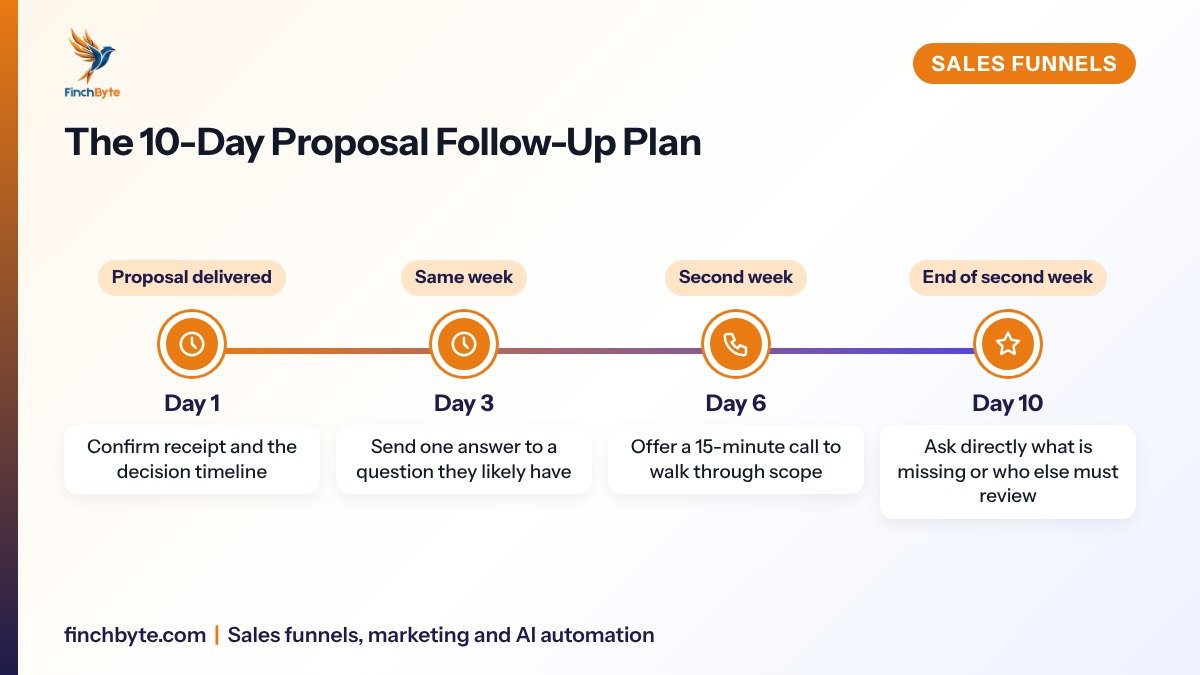
Long enterprise deals need a longer arc. This sequence is built for the proposals most B2B service teams actually send: a scoped project, a retainer, a support contract or a piece of custom work, decided within two to six weeks by one or two people.
| Day | Channel | Purpose of the touch |
|---|---|---|
| Day 1 | Confirm receipt, restate scope in one line, ask about the decision timeline | |
| Day 3 | Answer one question they probably have, from your discovery notes | |
| Day 6 | Email or phone | Offer a short call to walk through the parts that need discussion |
| Day 10 | Ask directly what is missing, who else must review, or whether to pause |
Four touches over ten days is enough for a small team to run consistently. Consistency beats volume: a sequence nobody forgets beats a nine-touch plan nobody follows.
What to write in each follow-up message
Every message in the sequence has the same shape: one reference to their situation, one new detail, one ask. Write it as you would speak it.
- Confirm and clarify (Day 1). "The proposal is attached as promised. To be sure I scoped it right, the priority is X and the deadline is Y. Who else will be reviewing it, and is there a date you need a decision by?" That last question is the most useful line in the whole sequence, because it turns silence into a timeline.
- Add one answer (Day 3). Pick a detail from your discovery notes that they raised and had not fully resolved: a data migration, a reporting format, who handles approvals. One paragraph, no attachment unless it is the thing you referenced.
- Offer a walkthrough (Day 6). Propose a specific 15-minute window rather than an open-ended "let me know your availability". Frame the call around the sections that need discussion, not around selling.
- Ask the direct question (Day 10). "Is there something in the scope or the pricing approach that does not work for you? If the timing is wrong, I am happy to park this and revisit next quarter." Giving them permission to say no is what often produces an honest reply.
- Close the loop. Whatever the answer, record it. A clean, well-explained decline that leaves the door open is a better outcome than a deal that sits in the pipeline for months.
Give every proposal a next step before you send it
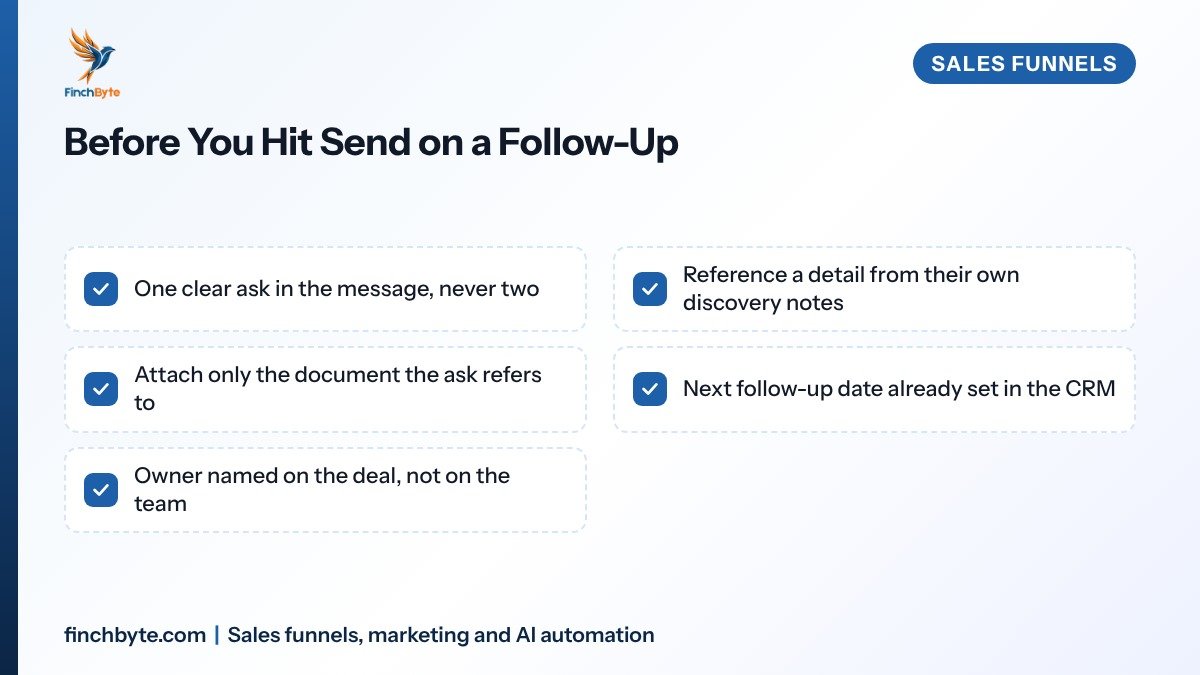
A proposal with no dated next action is the point where most follow-up fails. Before you press send, set three things in your CRM: the follow-up date, the owner of the deal, and the outcome you are working toward (a signed scope, a booked walkthrough, or an honest decline).
That discipline belongs in the pipeline itself. Our CRM pipeline setup guide covers the stages most service teams need; the proposal stage works best when it is split into "sent, awaiting review", "in discussion" and "awaiting decision", so a quote sitting untouched for nine days is visible to whoever opens the pipeline, not hidden among active deals.
One rule keeps this honest: no deal leaves a meeting or a call without a next step that has a date and a name on it. If the buyer cannot give you one, note that the deal is stalled and why, rather than inventing a follow-up date nobody believes in.
Use the channels your buyer actually reads
Email carries the sequence because it leaves a record the buyer can forward internally, which matters more than a reply. Phone and LinkedIn support it. A short call between Day 3 and Day 6 often resolves in two minutes what three emails cannot, especially when a procurement or finance person is involved.
If you contact them by phone or SMS as well as email, keep it to what they consented to and what your relationship justifies. In Canada, CASL sets expectations around electronic messages, and the Office of the Privacy Commissioner of Canada publishes plain-language guidance on consent. Existing business relationships with a person who gave you their details are a different situation from a purchased list; when in doubt, keep the thread to the enquiry they started.
Handle price objections without discounting first
When a buyer says the proposal is over budget, the instinct is to cut the number. Slow down. "Over budget" can mean the scope is too big for this year, the comparison supplier removed something you both assumed was standard, or the buyer simply needs an internal number to defend.
Ask which part is the problem, then offer options rather than a discount: phase the work, reduce the first engagement to the part with the clearest outcome, or move one deliverable to a later stage. Presenting two scoped options keeps your rate intact and gives the buyer something to take to their colleague. Our guide to service pricing pages explains the same logic for the public side of the funnel: buyers respond to clear scope, not to a lower number alone.
What to measure and who owns it
Follow-up is only a process if someone reviews it. Assign one owner, usually the sales manager or the founder in a smaller firm, and review these four things monthly.
- Time to first follow-up. How many proposals went out with a follow-up date set the same day? If the answer is not all of them, the problem is the CRM habit, not the message.
- Reply rate by touch. Which of the four touches actually gets answers? If Day 1 replies are strong and Day 3 produces nothing, your Day 3 message is generic and needs a real detail in it.
- Age of open proposals. Anything in "sent, awaiting review" for more than three weeks is either in discussion or it is not. Move it or close it.
- Reasons for lost deals. Scope, price, timing, competitor, no decision. Read them as a group each month; a pattern of "timing" says something different about your qualification than a pattern of "price" does.
Connect the proposal stage back to where the enquiry came from. Our UTM tracking guide shows how campaign links carry through to CRM records, so you can see whether proposals from one channel stall more often than another. If you want enquiry and proposal events in one report, our GA4 lead tracking walkthrough covers the setup.
Mistakes that stall proposals
- Sending the proposal late without telling anyone. A missed promise costs more than a slower scope.
- Attaching a long document and nothing else, then asking "any updates?" four times.
- Following up with the same person only, when three people needed to see the scope.
- Discounting before you know which part of the scope is the objection.
- Leaving won and lost deals in the pipeline because nobody wants to close them.
- Writing follow-up from the proposal instead of from your discovery notes.
A proposal is not waiting for a decision. It is waiting for someone to make one on your behalf.
Make the next step easy to say yes to
Good proposal follow-up for B2B services is a short, dated sequence with something new in every message, plus a pipeline that shows the truth about stalled quotes. Four touches in ten days, one owner per deal, one honest review each month.
Finchbyte builds the funnel around this stage: enquiry capture, a CRM pipeline with real stages and dated next actions, and the tracking that shows which proposals actually move. See how that works in our sales funnel setup service, or request a free growth audit to look at where your submitted proposals lose momentum.
Frequently asked questions
How long should you wait before following up on a proposal?
Send a first confirmation the day the proposal goes out, then touch the deal on days 3, 6 and 10. If the buyer gave you a decision date, align the sequence with that date instead of the calendar.
How many follow-ups are too many for a B2B proposal?
For most service deals, four touches over two weeks is enough before you ask directly whether the project is still live. Anything beyond that without new information tends to read as pressure rather than help.
Should you follow up by email or phone?
Email carries the sequence because the buyer can forward it internally, which is often what actually moves a decision. A short call between the second and third email resolves questions faster, especially when finance or procurement is involved.
What do you say when a client goes silent after a proposal?
Ask one specific question: who else needs to review the scope, or what part of the proposal does not work. Giving them a way to say the timing is wrong usually produces a more honest reply than a general check-in.
How do you follow up without sounding pushy?
Add something new in each message, such as an answer to a question from your discovery notes or one extra option in the scope. If a touch contains only a request for an update, it is a nudge rather than a follow-up.
Where should proposals sit in a CRM pipeline?
Split the proposal stage into sent and awaiting review, in discussion, and awaiting decision, with a follow-up date and an owner on every deal. That makes a quote that has sat untouched for weeks visible instead of hidden among active opportunities.
- #proposal follow-up for B2B services
- #proposal follow-up
- #B2B services
- #sales proposal
- #CRM pipeline
- #speed-to-lead
- #lead follow-up