
Sales Handover Process: Passing Qualified Leads to the Sales Team
A sales handover process that moves qualified leads to the right owner with the right notes. See the checklist, timings and CRM stages that stop drop-offs.
Finchbyte Team 9 min read

A lead fills in your booking form on a Tuesday morning, answers every question and asks for a quote for two rooms. Nobody in the CRM owns the record, so it waits behind a stack of older ones. On Friday a sales rep opens it, calls, and hears that the buyer already spoke to a competitor on Wednesday. Nothing in the campaign failed. The handover failed, and that is the cheapest leak in most funnels to fix.
This guide covers a sales handover process you can write down in an afternoon: what counts as qualified, what goes in the brief, who owns the lead and by when, and how to keep the CRM honest. It is written for owners and sales managers in B2B services, clinics, manufacturers and real estate teams, where a small group of people handle both the marketing and the closing.
What a Sales Handover Actually Means
A handover is the moment a lead stops being marketing's and becomes someone's named responsibility. It is not an email to a shared inbox or a mention in the Monday standup. A proper sales handover process has four parts: a qualified lead, a named owner, a written brief and a deadline for the first relevant contact.
Marketing owns everything before that line, meaning the landing page, the Enquiry form design and the scoring rules. Sales owns everything after it, from the first call to the proposal and the close. When both sides know where the line sits, arguments about "bad leads" and "slow follow-up" mostly disappear, because the numbers show which side moved.
Teams often mix this up with lead nurturing, which is what you do with people who are not ready yet. Nurturing is a marketing task with a schedule. Handover is a sales task with an owner. Confusing the two is how good enquiries end up in an email drip for eight weeks while the buyer buys elsewhere.
Where Handovers Go Wrong
Most broken handovers look like a tracking problem from the outside and a people problem once you look closer. Four patterns show up again and again in small teams.
- No definition. Marketing passes anything that filled a form, sales rejects most of it, and both sides stop trusting the funnel within a quarter.
- No named owner. The lead sits in a shared queue where everyone assumes somebody else has already called it.
- No context. The rep has a name and a phone number, so the first call repeats questions the buyer already answered twice.
- No clock. Nothing in the CRM says when the first contact is due, so speed depends entirely on whose desk is tidier.
The cost is quiet but real. A lead that waits two days is not simply slower; it is a booked meeting that probably never happens, and in a funnel that spends on ads every month, that money is spent twice for the same result. If the leak is earlier, in the form itself, fix that first, because a clean handover of messy data still gives you messy data.
Define Qualified Before You Route Anything
Qualified means the lead meets conditions you wrote down, not that someone liked the look of it. Write three to five conditions and put them in the form as questions, so the answer arrives with the record instead of being guessed later.
Typical conditions for a service business:
- Budget or deal size. A range the buyer picks from a dropdown, so a five-employee enquiry is not routed to the enterprise rep.
- Timeline. Ready in the next 30 days, later this year, or just researching.
- Authority or decision role. Who else is involved in the decision.
- Fit. Service, location and industry match what you actually sell.
Score the answers and split them into three lanes: hot (meets every condition), warm (meets most but the timeline is soft) and nurture (real interest, wrong timing). Hot goes to sales immediately. Warm goes to sales with a lower priority and a longer first-touch window. Nurture stays with marketing on a schedule. A clear split keeps the call list short enough that reps actually work it, and it keeps low-intent enquiries out of a sales pipeline where they would only sit and age.
The Handover Brief Sales Actually Needs
One page, six fields, two minutes to read. Anything longer does not get read, and a rep who has to dig through a form export will call cold.
- Buyer and company. Correct name, role, best number, and the time zone if you serve more than one.
- Source and campaign. Which landing page or ad the lead came from, so the rep opens with the right promise.
- Requested outcome. What the buyer asked for in their own words, quoted from the form.
- Qualification answers. Budget range, timeline, decision makers and fit.
- Assets already sent. Brochure, pricing guide or case study, with dates, so nobody sends it twice.
- Next action and due time. One instruction, such as "call before 4 pm today, ask about installation dates".
That last field matters more than the other five. A brief that ends with a question mark produces a call next week; a brief that ends with an action and a time produces a call today. Keep it in the CRM record rather than in an email, because emails get archived and CRM records get worked.
Set the Clock and the Owner
Speed-to-lead only works when someone is accountable for it. Decide the maximum time from form fill to first relevant contact for each lane, and put that deadline in the CRM as a task on the record, not in someone's memory.
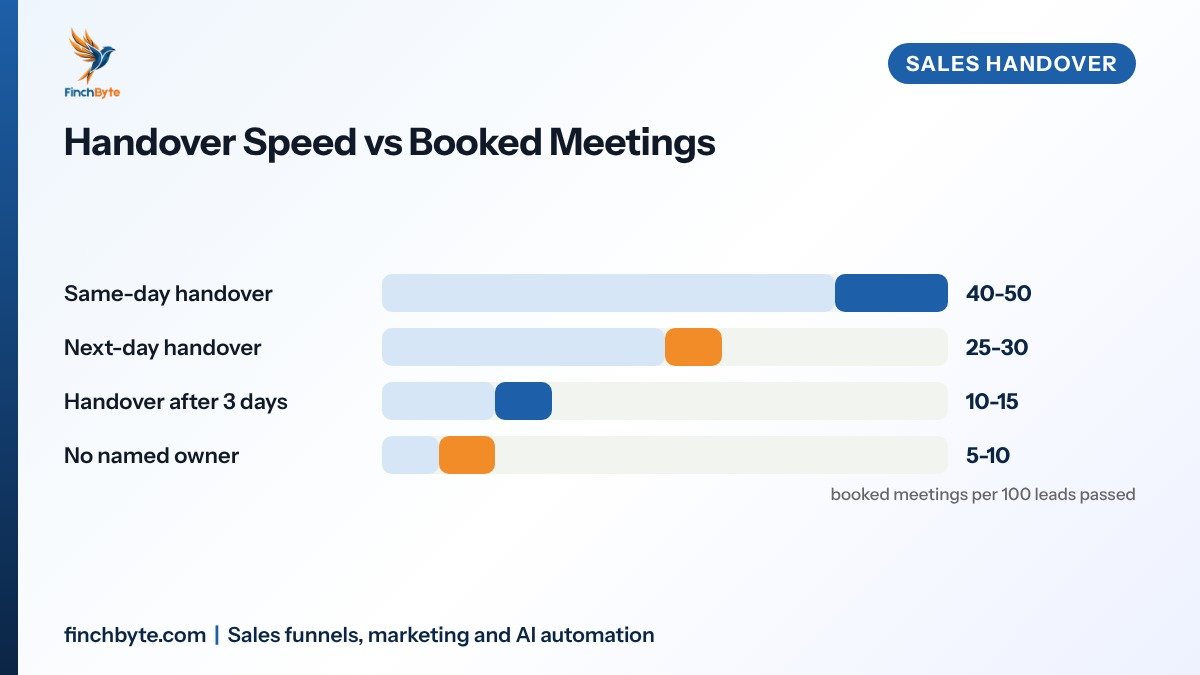
The pattern to take from those ranges is simple: the same-day lane earns roughly three to five times what a three-day lane earns, and an unassigned lead earns almost nothing. For example, a dental clinic that passes 40 enquiries a month would be working from a much better position handing over hot ones the same day than clearing the queue on Friday afternoon.
Name a backup for every owner. A single person on leave should never be the reason a month of paid leads goes cold, and a documented backup is also what makes the process survive a hire or a departure.
Route Leads Inside the CRM
Routing is where the process becomes automatic instead of aspirational. Build it once and new leads land in the right place with the right task attached.
- Capture with the questions built in. Use conditional fields on the form so a lead who picks "just researching" never enters the hot lane. Keep the Lead qualification checklist as the source of your conditions.
- Assign on save. Auto-assign by service, city or deal size, and show the owner's name on the record so a second person never picks it up blind.
- Create a task with a deadline. The record saves with a call task due the same day for hot leads, and the next business day for warm ones.
- Notify in the channel people actually read. A short message to the owner with the requested outcome and the due time beats another email in a crowded inbox.
- Log the outcome, not just the attempt. Every first contact ends with a disposition such as booked, call back, not fit or no answer, so you can see what happens after handover rather than guessing.
Keep the pipeline stages few and honest. A working set for most teams is New, Attempted, Connected, Qualified Meeting, Proposal and Won or Lost. Each stage needs an entry condition and an owner. If a stage has neither, it becomes a car park, and car parks are where funnels quietly die. The CRM pipeline setup guide covers stage design in more detail.
A lead without a named owner and a due time is not a lead; it is a rumour.
Handover Rules by Business Type
The mechanics stay the same; what changes is who takes the lead and how fast.
- Clinics. The front desk or a patient coordinator usually owns first contact, because they answer the phone anyway. Book the appointment on that first call rather than promising a callback. The Appointment booking funnel plan shows how to route straight into a slot.
- B2B services. One senior owner per opportunity, since the first conversation often needs subject-matter credibility. Proposal handover matters as much as lead handover here, and the Proposal follow-up plan sets out the days and messages.
- Manufacturers. Enquiries frequently arrive with incomplete specs, so route to a technical salesperson who can ask the right follow-up questions instead of a general inbox. The Quote request form for manufacturers is the usual place to fix missing detail.
- Real estate. Speed beats polish. Portal leads age within hours, so route by project and pin every agent to a first-call window measured in minutes. The Real estate lead funnel covers the site-visit step that follows.
Whatever the industry, the same handover rules apply to the people who came in through the side doors too, including walk-ins, referrals and event lists. A Lead follow-up process that only covers form fills leaves half the pipeline unowned.
Common Mistakes to Avoid
- Passing volume instead of qualified leads. Sales starts rejecting records, then stops working the queue at all.
- Handing over by email only. The thread is unread and untracked, so nothing shows up in reporting later.
- Making the rep rebuild the context. Repeating questions the buyer already answered costs trust on the first call.
- Leaving leads in a shared queue. Everyone assumes someone else called, and nobody did.
- One owner with no backup. Leave, illness or a sales call blocks the whole funnel.
- Counting only form fills. Report booked meetings and won deals, or the team optimises for noise.
What to Ask Before Hiring an Agency
If an agency or a freelancer is running your funnel while your own team closes, the handover line crosses a company boundary, so pin it down before the work starts.
- Scope. Who writes the qualification rules, builds the routing and owns the CRM fields.
- Reporting. Whether reports show booked meetings and pipeline value, not just clicks and form fills.
- Ownership. Who owns the CRM account, the phone numbers and the lead data, and what happens on day one of an exit.
- Timelines. How fast new leads are routed and how routing bugs get fixed.
- Tracking. Whether call outcomes and dispositions are recorded, so handover quality is measurable rather than argued about.
Ask to see one real lead traced end to end, from ad click to disposition, before you sign. Any agency running a proper funnel can show that in a few minutes, and one that cannot usually means the handover is not designed at all. Finchbyte builds and runs funnels with routing and follow-up built in; see the Sales funnel setup service for how that works.
Conclusion
A sales handover process is a short written agreement: qualified means these conditions, this person owns it, this is the brief, and the first contact happens by this time. Write it on one page, put the deadlines in the CRM, and check booked meetings weekly rather than counting form fills. Most teams recover more pipeline from that one page than from another month of ad spend.
Want this set up for your business? Book a free growth audit or Talk to Finchbyte.
Disclaimer: Results vary by business, market, budget and execution. This article is general guidance, not a promise of specific rankings, leads or revenue.
Frequently asked questions
What is a sales handover process?
It is the documented moment a lead moves from marketing to a named sales owner, with a short written brief and a deadline for the first relevant contact. It covers four things: a qualified lead, a named owner, a brief and a due time.
How fast should a qualified lead be handed over?
Same day is the target for hot leads, ideally within an hour of the form fill, and the next business day at the latest for warm ones. Leads contacted after three days convert far less because the buyer has usually shortlisted someone else.
Who should own the handover, marketing or sales?
Marketing owns everything before the qualification line and sales owns everything after it, but the handover itself needs one accountable owner, usually a sales coordinator or the marketing manager who monitors the inbox. The rule is that no lead is ever left without a named person.
What goes in a lead handover brief?
Buyer name, role and best number; the source and campaign; what the buyer asked for in their own words; the qualification answers such as budget range, timeline and decision makers; anything already sent; and one next action with a due time. Six fields, readable in two minutes.
How do I stop sales from rejecting marketing leads?
Agree the qualification conditions in writing and build them into the form as questions, so the lead arrives with the answers. Then review dispositions monthly, since a rejection reason such as "wrong budget" tells you exactly which form field or ad to change.
How many CRM pipeline stages do we need?
Five or six is enough for most small teams, such as New, Attempted, Connected, Qualified Meeting, Proposal, and Won or Lost. Each stage needs an entry condition and an owner, otherwise it becomes a dumping ground where leads sit unnoticed.
Does handover matter for referrals and walk-ins?
Yes. Referrals, walk-ins, event lists and inbound calls should enter the same pipeline with the same owner and due-time rules, otherwise you will keep losing the highest-intent enquiries in your business while reporting only on form fills.
- #sales handover process