Real Estate Lead Funnel: From Portal Click to Site Visit
A real estate lead funnel that turns portal clicks into booked site visits. See the stages, reply timings and follow-up steps your team can run this week.
Finchbyte Team 9 min read

You pay a portal for every lead it sends, then watch half of them go cold in a shared spreadsheet that three agents open when it is quiet. A working real estate lead funnel fixes that one step at a time: the enquiry lands in a CRM, someone owns it within minutes, and the only goal of the next two weeks is a booked site visit. This guide covers the stages, the reply timings and the follow-up messages a small property team can put in place this week.
It also covers the part most teams skip, which is measuring the funnel by site visits and closures rather than by raw lead counts. If you want the wider picture of how a funnel works before you narrow it to property, What Is a Sales Funnel explains the stages in plain terms.
Why Portal Leads Go Cold in Property Teams
The leak is almost never the lead source. It is the handoff between the portal and the person who can actually book a visit. Leads arrive as SMS alerts or CSV exports, agents reply to two or three between site visits, and the buyer who asked a question at 7 pm gets an answer at 11 am the next day, by which time they have spoken to two other projects.
Say a project marketing team gets 120 enquiries a month from portals and paid ads. If the team replies within 15 minutes and books a visit with roughly one buyer in three, that is around 35-40 visits a month. Push the same leads out over a day and the same budget might produce 6-12 visits. Nothing about the leads changed. Only the funnel did.
Stage 1: Capture Every Enquiry in One Place
Before any automation, every enquiry needs one home. Portals, WhatsApp, walk-ins, calls to a reception number and paid ad forms all have to land in the same CRM, or no one can see which source actually produces visits.
- Portal leads. Import or push them hourly with the project name, budget and configuration the buyer filtered on.
- Ad form leads. Send them straight from the landing page into the CRM with the campaign and keyword tagged, the way UTM Tracking for Small Businesses describes.
- WhatsApp and call leads. Log them as records with the agent name and the time of the first message, not as a chat thread on a personal phone.
- Walk-in and reference leads. Enter them the same day with a source label, so referrals stay visible in reporting.
One rule matters more than the rest: no lead lives only on an agent's phone. When that agent leaves, the follow-up history leaves with them. If your team needs help setting up the records and stages, CRM Pipeline Setup for Small Service Businesses covers the fields and stages that hold up.
Stage 2: Send Buyers to a Page Built for One Project
A generic corporate homepage wastes a warm buyer. Each campaign should point to a page for one project or one unit type, with the details a buyer actually needs before agreeing to visit.
- Project facts. Location, configurations, price range, possession timeline and RERA registration details.
- Visual proof. Master plan, floor plans, a project video and real photographs rather than only renders.
- One clear action. Book a site visit with a date and time picker, plus a WhatsApp button for buyers who would rather type.
- Cost transparency. An indicative cost sheet or a link to it, because buyers who see a range self-qualify on budget before you spend time on them.
The booking form should ask for the minimum that lets an agent prepare: name, phone, budget range, configuration and a preferred slot. Everything else comes out, following the same logic as Enquiry Form Design. For the page layout itself, Landing Page Design for Service Businesses applies just as well to property campaigns.
Stage 3: Reply Fast Enough to Beat the Other Project
Speed is the single lever with the clearest effect, because a buyer comparing three projects usually decides whom to visit within the first hour. Under 15 minutes is a realistic target for a small team once routing and templates are set up.
| First reply time | Site visits booked | What is happening |
|---|---|---|
| Under 15 minutes | 25-35 | Buyer is still comparing and available on the phone |
| 15-60 minutes | 15-20 | Buyer has usually spoken to one competitor already |
| 2-24 hours | 5-10 | Mostly polite replies, few visits agreed |
| After 24 hours | 0-5 | Treated as spam or the buyer has booked elsewhere |
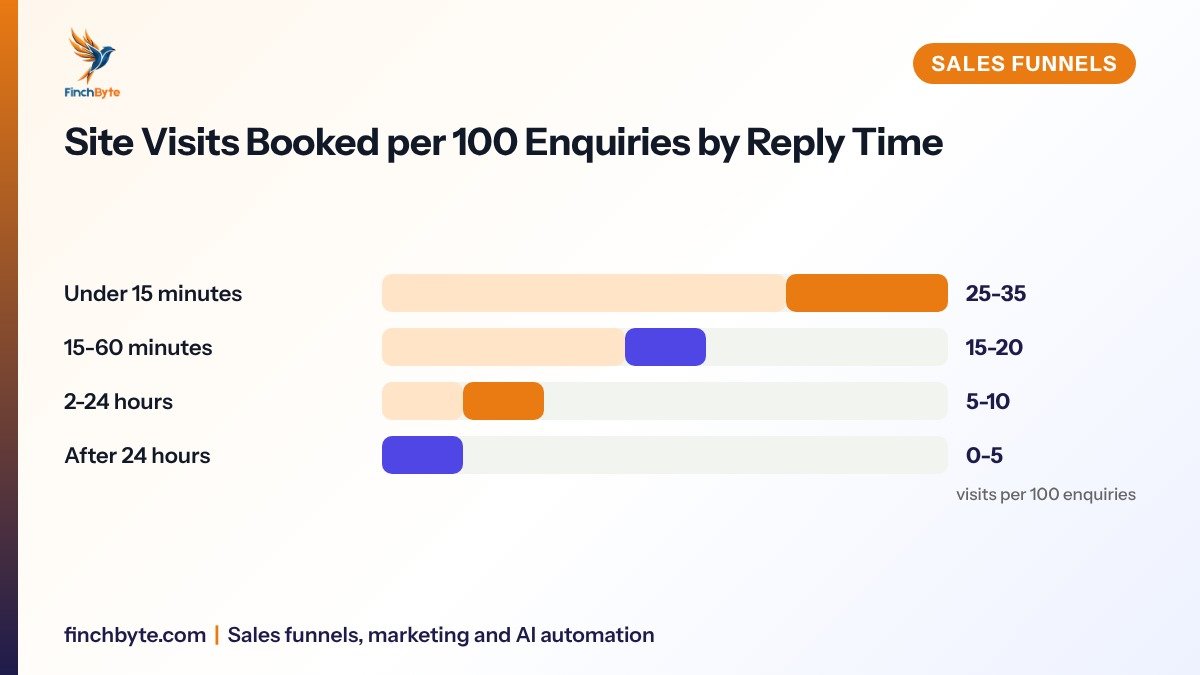
The numbers are counts of visits booked per 100 enquiries, and they are illustrative ranges for a property enquiry team rather than a promise for any one project. Location, ticket size and the quality of the ad creative all move them. The point is the shape of the curve: the drop between replying inside 15 minutes and replying next morning is the biggest leak in most funnels. A chatbot can hold the conversation and collect budget and configuration details until a human picks up, provided the handover rules are clear, as covered in AI Chatbot Handover Rules.
Stage 4: Qualify Before You Send a Car
Not every enquiry deserves a site visit slot, and unqualified visits cost fuel and agent hours. Qualification for property is short and mostly factual.
- Budget against price. Does the stated budget cover the entry price plus taxes and registration?
- Timeline. Are they buying in the next 1-3 months, comparing for the next year, or just researching?
- Decision makers. Who else sees the property, and can they join the visit?
- Financing. Home loan pre-approved, in process, or not started.
Score these lightly rather than building a complex model. A buyer with matching budget and a 90-day timeline gets a same-day call. Someone researching for next year gets a polite nurture track and a project update list instead of a call every week. For a fuller scoring sheet, Lead Qualification Checklist for Service Businesses works with light edits for property.
Stage 5: Run a 14 Day Follow Up Plan
Most visits are booked by the third or fourth useful touch, not the first message. A fixed plan keeps agents from going silent after one unanswered call, and keeps every touch worth something to the buyer.
- Call within 15 minutes. Confirm budget and configuration, then offer two specific site visit slots rather than asking when they are free.
- Send a shortlist the same day. Two or three matching units, a location map pin and the indicative cost sheet in one message.
- Confirm the visit 24 hours ahead. A short reminder with the agent's name, the meeting point and the drive time from their area.
- Follow up after the visit within 48 hours. Answer the two questions they raised on site and share the payment plan or loan documents.
- Close the loop on day 14. One honest message asking whether they are still looking, then move them to a monthly update list if they are not.
| Stage | Day | What the buyer receives |
|---|---|---|
| First contact | 0-1 | Call, shortlist and site visit slot |
| Cost clarity | 1-2 | Cost sheet and home loan documents |
| Visit reminder | 3-4 | Reminder, map pin and agent details |
| Post visit | 7-8 | Floor plan and payment plan video |
| Comparison | 11-12 | Nearby project comparison and upgrades |
| Check in | 14-15 | Honest question and next step |
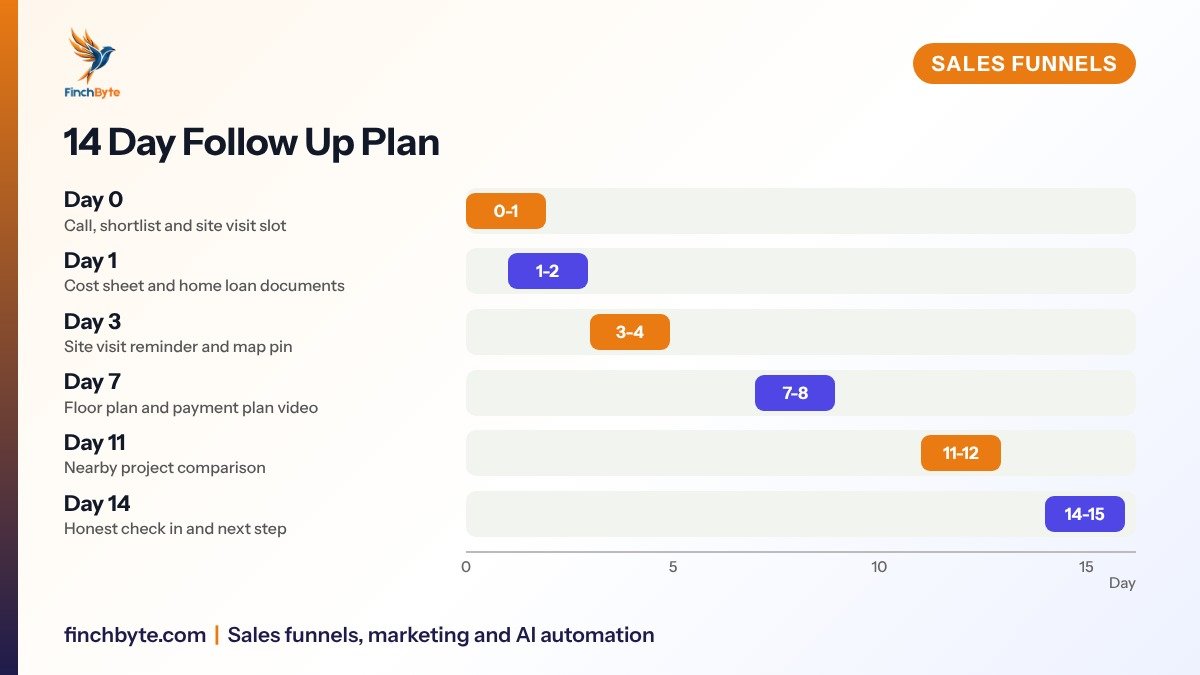
Each message should carry one new piece of information. Four identical "just checking in" texts teach the buyer that your messages can be ignored.
Stage 6: Measure Visits, Not Leads
Reporting on lead counts rewards teams for volume and hides the leak. Reporting on visits and closures shows which source and which reply speed actually produce business.
| Metric | What it measures | Monthly number to expect |
|---|---|---|
| Leads per month | Volume from each source | 80-150 |
| Leads replied within 15 minutes | Speed to first contact | 60-80 |
| Site visits booked | Enquiries that reach a visit | 15-30 |
| Visits attended | Bookings that actually show up | 50-70 |
| Bookings from visits | Visits that turn into a sale | 3-8 |
Read these as counts out of the 100 enquiries in the example above, not as fixed targets for your project. Track them monthly per source, so a portal sending 60 cheap leads that never produce a visit stops getting the budget a source sending 20 leads that do deserves. Your Monthly Marketing Report should show these five numbers side by side with spend, and the same visit metric is what GA4 Lead Tracking helps you tie back to campaigns.
A lead is only a lead until someone speaks to it; after that it is either a booked visit or a follow-up task.
Common Mistakes to Avoid
Most property funnels fail in the same handful of ways. Fix these before adding anything new.
- Sharing one login across agents. Nobody owns the lead, so nobody calls it. Assign every record to a named person with a due date.
- Sending leads to a homepage. Buyers came for one project and get a corporate page with no price or floor plan.
- Chasing every lead equally. A year-out researcher gets the same five calls as a ready buyer, and both suffer.
- Following up with no new information. Repeating "interested?" trains buyers to stop replying.
- Reporting on lead counts alone. Volume looks good while visits and closures quietly fall.
- Keeping history on personal phones. When an agent leaves, the buyer's whole thread disappears with them.
What to Ask Before Hiring an Agency
If you plan to hand the funnel to an outside team, ask these questions before signing anything.
- Scope. Who builds the landing pages, writes the follow-up messages and configures the CRM, and who answers when a portal feed breaks?
- Reporting. Which numbers appear in the monthly report, and does it report booked visits and closures rather than clicks and impressions?
- Ownership. Who owns the ad accounts, the CRM data, the landing pages and the enquiry history if you end the contract?
- Timelines. What is the build sequence for the first 60 days, and what is expected from your team each week?
- Tracking. How are portal, WhatsApp and call leads tied back to campaigns, and how do you see it yourself between reports?
Finchbyte builds and runs property funnels end to end, from landing pages and lead capture to follow-up automation, on the Sales funnel setup service, with the paid side measured on qualified visits under Digital marketing. See how it has worked for other teams in Case studies, or check what a retainer covers on the Pricing page.
Conclusion
A real estate lead funnel works when one system holds every enquiry, someone replies inside 15 minutes, qualification happens before a car is sent, and 14 days of follow-up each add something new. Fix the reply time first, then the reporting, and the same lead spend starts producing more visits without a single new portal subscription.
Want this set up for your business? Book a free growth audit or Talk to Finchbyte.
Disclaimer: Results vary by business, market, budget and execution. This article is general guidance, not a promise of specific rankings, leads or revenue.
Frequently asked questions
How fast should a real estate team reply to a portal lead?
Inside 15 minutes if you can manage it, and the same day at the very latest. Buyers comparing three projects usually decide whom to visit in the first hour, so a next-morning reply often arrives after they have already booked somewhere else.
How many follow-up messages before a lead goes cold?
Plan for six to eight useful touches over about 14 days. Each one should carry new information such as a cost sheet, a floor plan video or a comparison, because repeated "just checking in" messages get ignored.
Should property leads go to WhatsApp or a phone call first?
Call first, then continue on WhatsApp. A short call confirms budget, timeline and who else is deciding, and WhatsApp then carries the shortlist, map pin and documents. Log both in the CRM so the history stays with the business.
What is a good site visit booking rate?
In the example used in this guide, 15-30 visits booked from every 100 live enquiries is the range a team that replies quickly and qualifies properly can work towards. Ticket size, location and ad creative all move the number, so compare your sources against each other rather than against a fixed target.
Do real estate leads need a landing page or can they go to the portal listing?
A project-specific landing page gives you the buyer's details, the campaign source and a booking slot, which a portal listing does not. Keep one page per project or unit type with floor plans, an indicative cost range and a date-and-time booking form.
Which CRM stages suit a property enquiry funnel?
Keep it short: New Enquiry, Contacted, Qualified, Visit Booked, Visited, and then Closed Won, Closed Lost or Nurture. Too many stages and agents stop updating them; the goal is to see at a glance which leads need a call today.
How do I know which lead source is worth the money?
Report booked visits and closures per source, not lead counts. A portal sending 60 leads that produce two visits is costing more than one sending 20 leads that produce eight, even when the per-lead price looks cheaper.
- #real estate lead funnel